Gareth Brinn manages a three-person documentation team at Gravitee, an API management company. He came to technical writing through an English degree and a master’s in technical communication, and sees his non-engineering background as a strength: “I am the common denominator. If I know how to do it, everyone should be able to do it.”
“Documentation is almost like the hand. It’s giving the autonomy to do tasks without relying on other people.”
That metaphor drives how Brinn positions docs internally. Sales teams send prospects to the documentation before on-site visits. Solutions engineers don’t need to write custom explanations. And when prospects are evaluating Gravitee, docs are part of what they’re judging.
“If they’re using documentation to evaluate, then it needs to be a good experience from start to finish. And then they’ll hit that book-a-demo button.”
And the best way to improve that experience? Change how you view documentation as a team.
“If you’re seeing it as a cost center rather than an investment, then it’s already going to fail, because users expect documentation to drive autonomy.”
This shift in how a company values documentation helps turn internal feedback from vague comments into concrete improvements. Instead of ‘we need more docs,’ the feedback becomes ‘this code snippet doesn't work’ or ‘this configuration is out of date.’
Larry Ullman saw this dynamic at a much larger scale. As the first technical writer at Stripe, he spent nine years building their documentation and watched the impact compound across sales, hiring, fundraising, and engineering productivity.
“I can’t even say how much Stripe benefited from having this reputation of great docs. I’m sure it helped with investing and hiring — not just the technical writing team, but great engineers. Because they want to work at a place where they know their product is going to be well-documented.”
His team tracked concrete metrics tying documentation directly to revenue: time from first doc visit to first paid transaction, signups from documentation pages, and when users read the right docs but still contacted support — flagging specific doc failures.
But the number that made leadership pay attention was internal.
“If you could make engineers five percent more effective, it was going to save the company the equivalent of around $140 million. The numbers just get bonkers really quickly.”
The reason?
“Docs are kind of infra[structure]. You don’t want to be cheap on infra.”
Kate Mueller at KnowledgeOwl found the same pattern through customer research: “[When interviewing customers] one of the recurring themes was, ‘when we were looking at your product, we looked at your docs as well. And it was clear that both the product and the documentation were created by people who care about documents.’” For KnowledgeOwl — a product built for other writers — documentation quality is itself a marketing technique.
And Christopher Gales raises the flip side: what happens when doc quality slips? “Will that ever rise to the point where a customer doesn’t renew because of lower doc quality? It’s a very lagging indicator to find that out.”
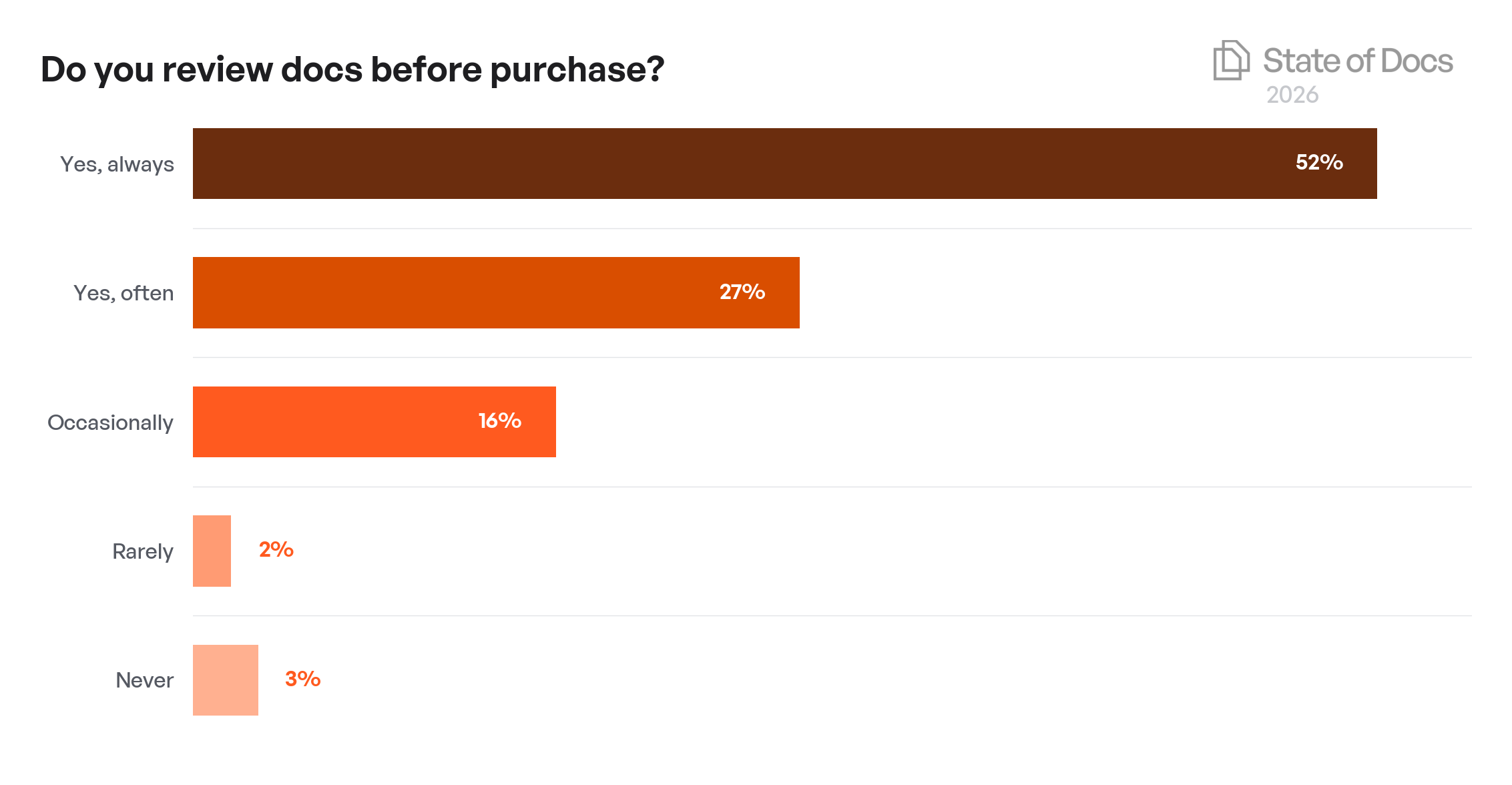
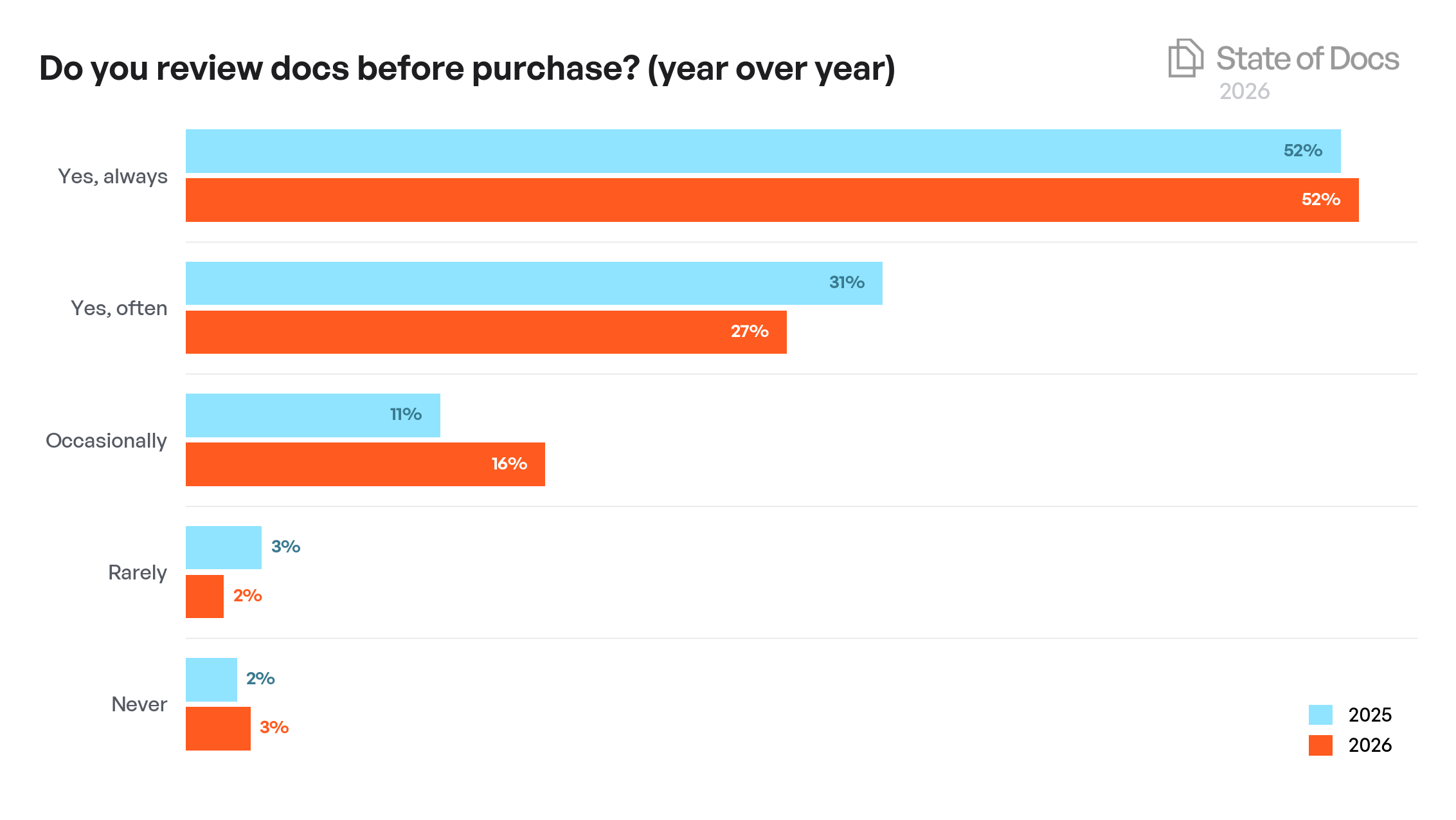
The survey data confirms what these practitioners describe: 80% of decision-makers review docs before buying. The gap isn’t in whether documentation matters — it’s in whether teams are measuring and communicating that impact in terms leadership understands.
Gareth Brinn manages a three-person documentation team at Gravitee, an API management company. He came to technical writing through an English degree and a master’s in technical communication, and sees his non-engineering background as a strength: “I am the common denominator. If I know how to do it, everyone should be able to do it.”
“Documentation is almost like the hand. It’s giving the autonomy to do tasks without relying on other people.”
That metaphor drives how Brinn positions docs internally. Sales teams send prospects to the documentation before on-site visits. Solutions engineers don’t need to write custom explanations. And when prospects are evaluating Gravitee, docs are part of what they’re judging.
“If they’re using documentation to evaluate, then it needs to be a good experience from start to finish. And then they’ll hit that book-a-demo button.”
And the best way to improve that experience? Change how you view documentation as a team.
“If you’re seeing it as a cost center rather than an investment, then it’s already going to fail, because users expect documentation to drive autonomy.”
This shift in how a company values documentation helps turn internal feedback from vague comments into concrete improvements. Instead of ‘we need more docs,’ the feedback becomes ‘this code snippet doesn't work’ or ‘this configuration is out of date.’
Larry Ullman saw this dynamic at a much larger scale. As the first technical writer at Stripe, he spent nine years building their documentation and watched the impact compound across sales, hiring, fundraising, and engineering productivity.
“I can’t even say how much Stripe benefited from having this reputation of great docs. I’m sure it helped with investing and hiring — not just the technical writing team, but great engineers. Because they want to work at a place where they know their product is going to be well-documented.”
His team tracked concrete metrics tying documentation directly to revenue: time from first doc visit to first paid transaction, signups from documentation pages, and when users read the right docs but still contacted support — flagging specific doc failures.
But the number that made leadership pay attention was internal.
“If you could make engineers five percent more effective, it was going to save the company the equivalent of around $140 million. The numbers just get bonkers really quickly.”
The reason?
“Docs are kind of infra[structure]. You don’t want to be cheap on infra.”
Kate Mueller at KnowledgeOwl found the same pattern through customer research: “[When interviewing customers] one of the recurring themes was, ‘when we were looking at your product, we looked at your docs as well. And it was clear that both the product and the documentation were created by people who care about documents.’” For KnowledgeOwl — a product built for other writers — documentation quality is itself a marketing technique.
And Christopher Gales raises the flip side: what happens when doc quality slips? “Will that ever rise to the point where a customer doesn’t renew because of lower doc quality? It’s a very lagging indicator to find that out.”
The survey data confirms what these practitioners describe: 80% of decision-makers review docs before buying. The gap isn’t in whether documentation matters — it’s in whether teams are measuring and communicating that impact in terms leadership understands.
Eighty percent of decision-makers review documentation before buying. The case that docs matter commercially is settled. What isn't settled is whether the teams behind those docs are treating them accordingly.
The featured voices in this section span the full range of that gap. On one end, a solo technical writer at a startup whose docs site outperforms its marketing site on organic traffic. On the other, the first technical writer at Stripe, who built revenue metrics connecting documentation directly to paid transactions, and watched a five-percent improvement in engineering effectiveness translate to nine figures in savings. The common thread is not about company size, but about whether leadership has been given a number to care about.
This section covers how much documentation matters to buyers, where teams are seeing commercial impact today, and where the largest untapped opportunities are — including one category that barely existed last year.
How much documentation matters when choosing a product
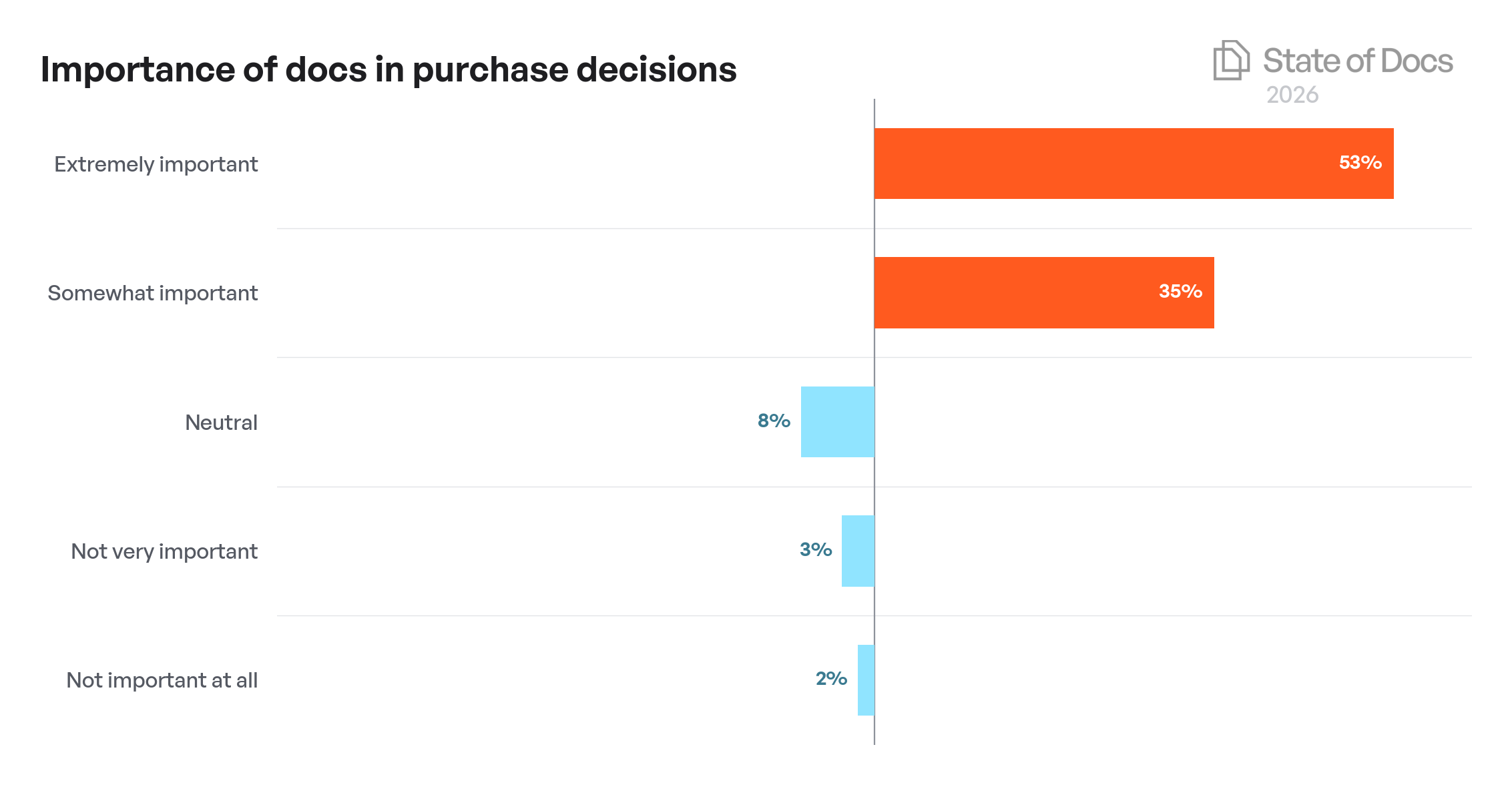
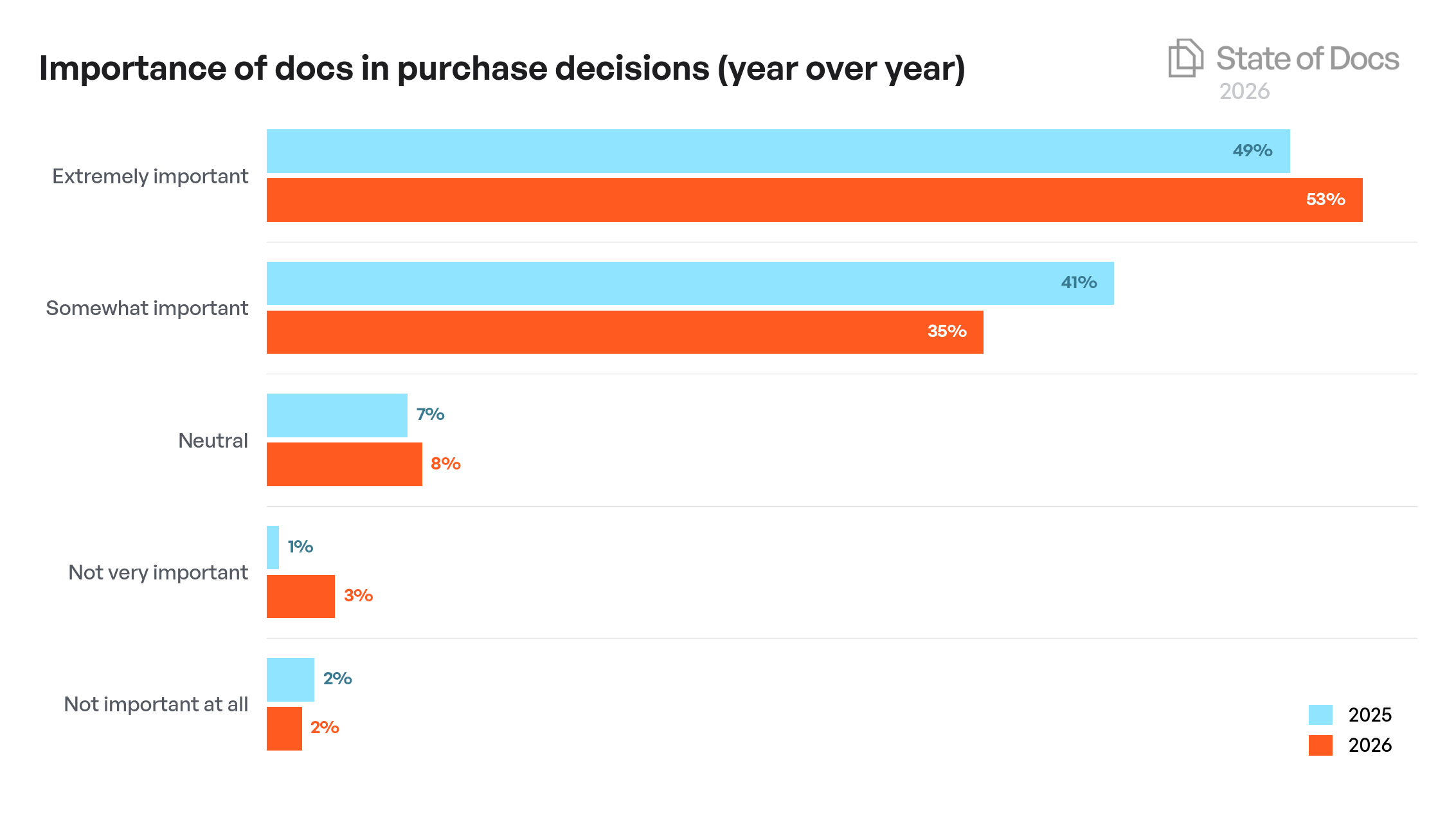
The numbers are emphatic: 80% of decision-makers always or often review documentation before buying, and 88% rate it extremely or somewhat important. More than half say “extremely important.” Only 5% say docs don’t matter much.
“I don't know how you shop for software, but if I'm looking for a solution, I don't want to look at the marketing site. I want to look at the docs.”
CT Smith
Payabli
“Docs are our developer enablement engine. When docs work well, developers can move faster, build more confidently, and discover and adopt new features without waiting on anyone.”
Usha Mandya
Docker
“When the information architecture is right, customers can self-serve the sales process. They find what they need, they understand the product, they make the decision — without needing a call.”
Delfina Hoxha
Little Language Models
“The main purpose for all docs is to help users use the product. Tied to that is helping users discover and buy the product. It all comes down to removing friction between the user and the product.”
Diana Payton
HackMamba | Technical Writing Uncensored
“I don't know how you shop for software, but if I'm looking for a solution, I don't want to look at the marketing site. I want to look at the docs.”
CT Smith
Payabli
“Docs are our developer enablement engine. When docs work well, developers can move faster, build more confidently, and discover and adopt new features without waiting on anyone.”
Usha Mandya
Docker
“When the information architecture is right, customers can self-serve the sales process. They find what they need, they understand the product, they make the decision — without needing a call.”
Delfina Hoxha
Little Language Models
“The main purpose for all docs is to help users use the product. Tied to that is helping users discover and buy the product. It all comes down to removing friction between the user and the product.”
Diana Payton
HackMamba | Technical Writing Uncensored
Where docs have impact — and where teams want more
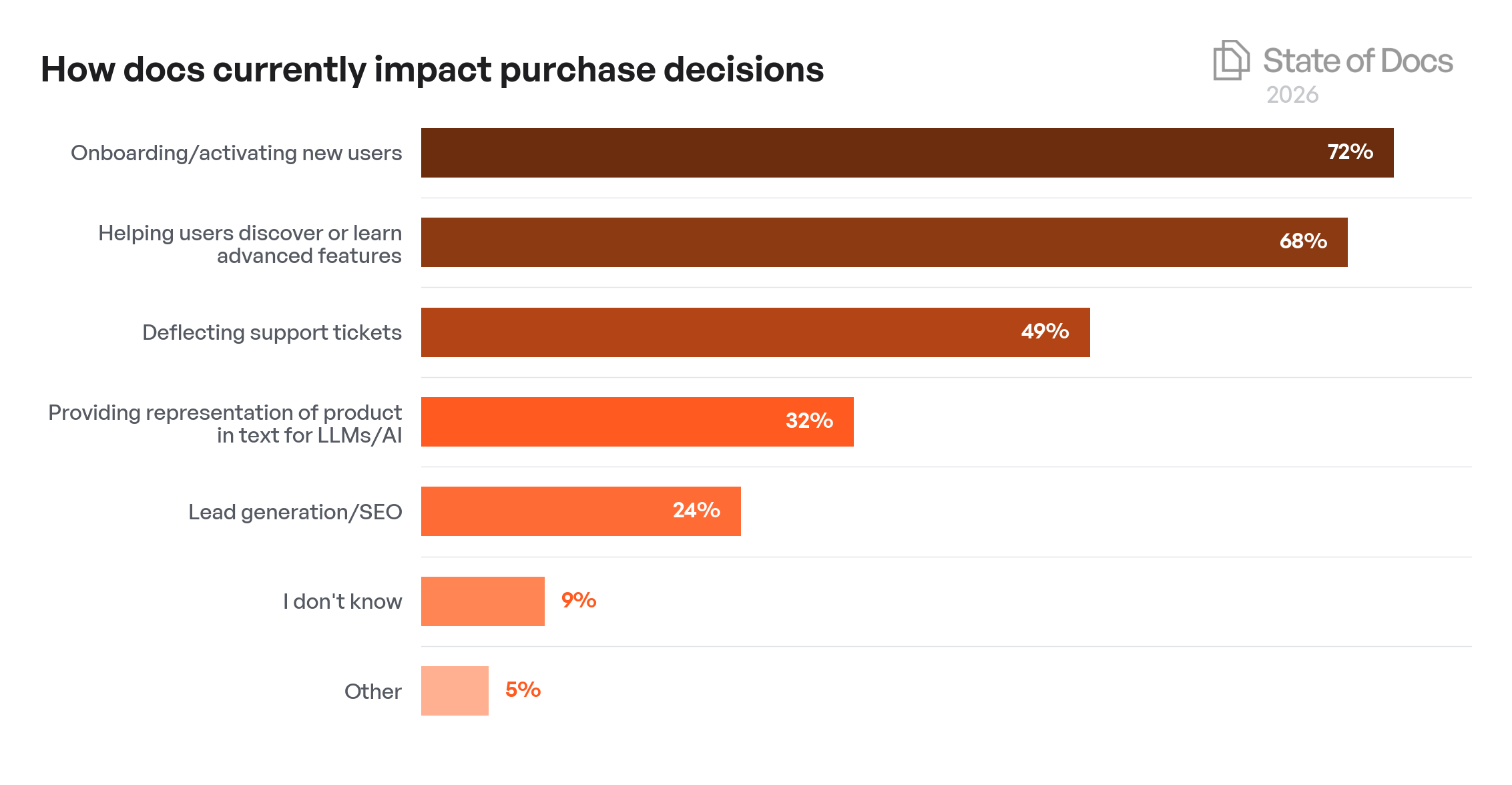
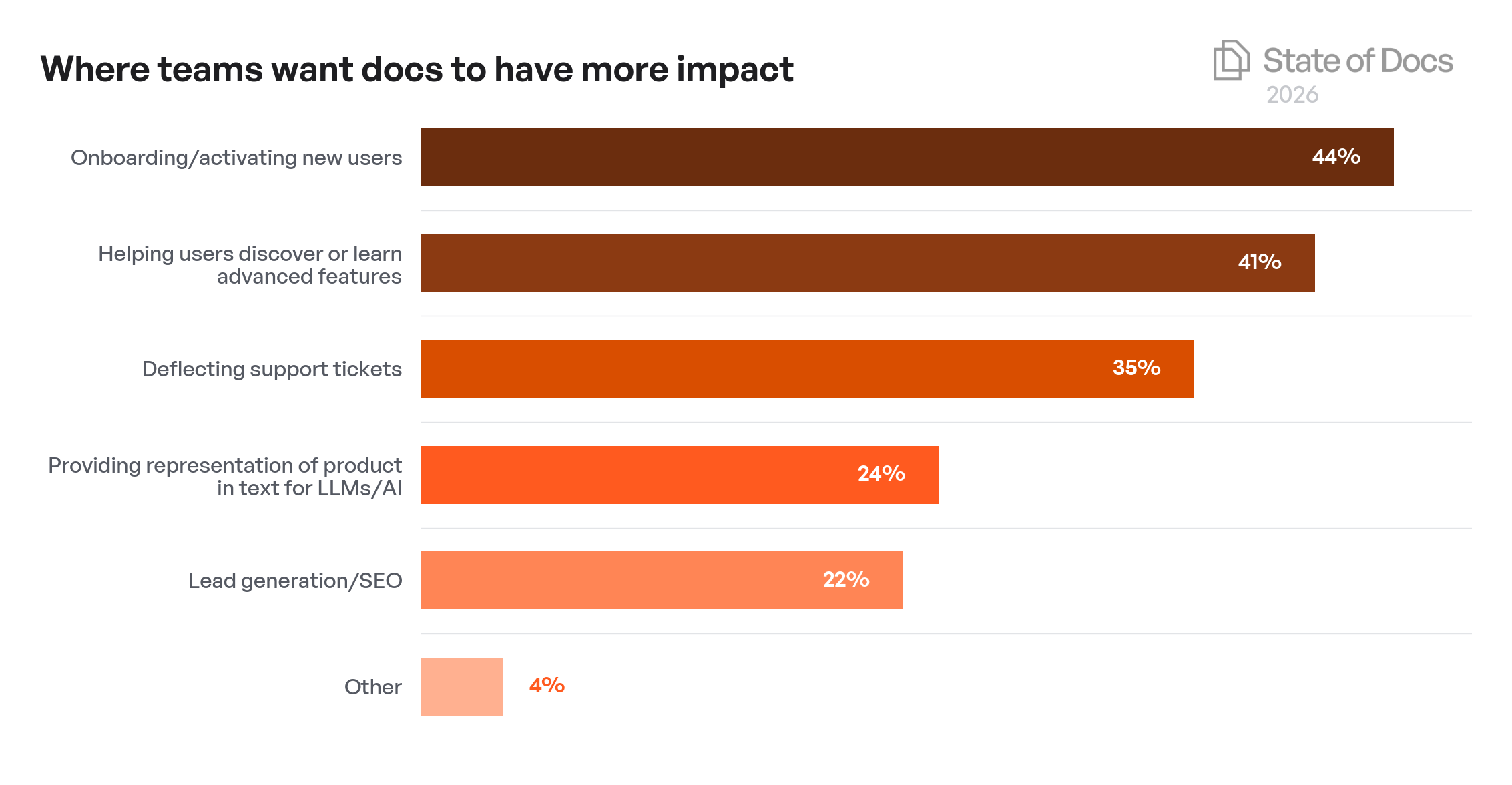
Onboarding and feature discovery dominate both current and desired impact. 72% say docs currently impact onboarding, and 68% say they impact feature discovery. These are the table-stakes areas where documentation already delivers.
The emerging areas are further down the list:
LLM/AI representation: 32% current impact — teams see major untapped potential here
Lead generation/SEO: 24% current impact — this is the area where aspiration most closely matches current reality
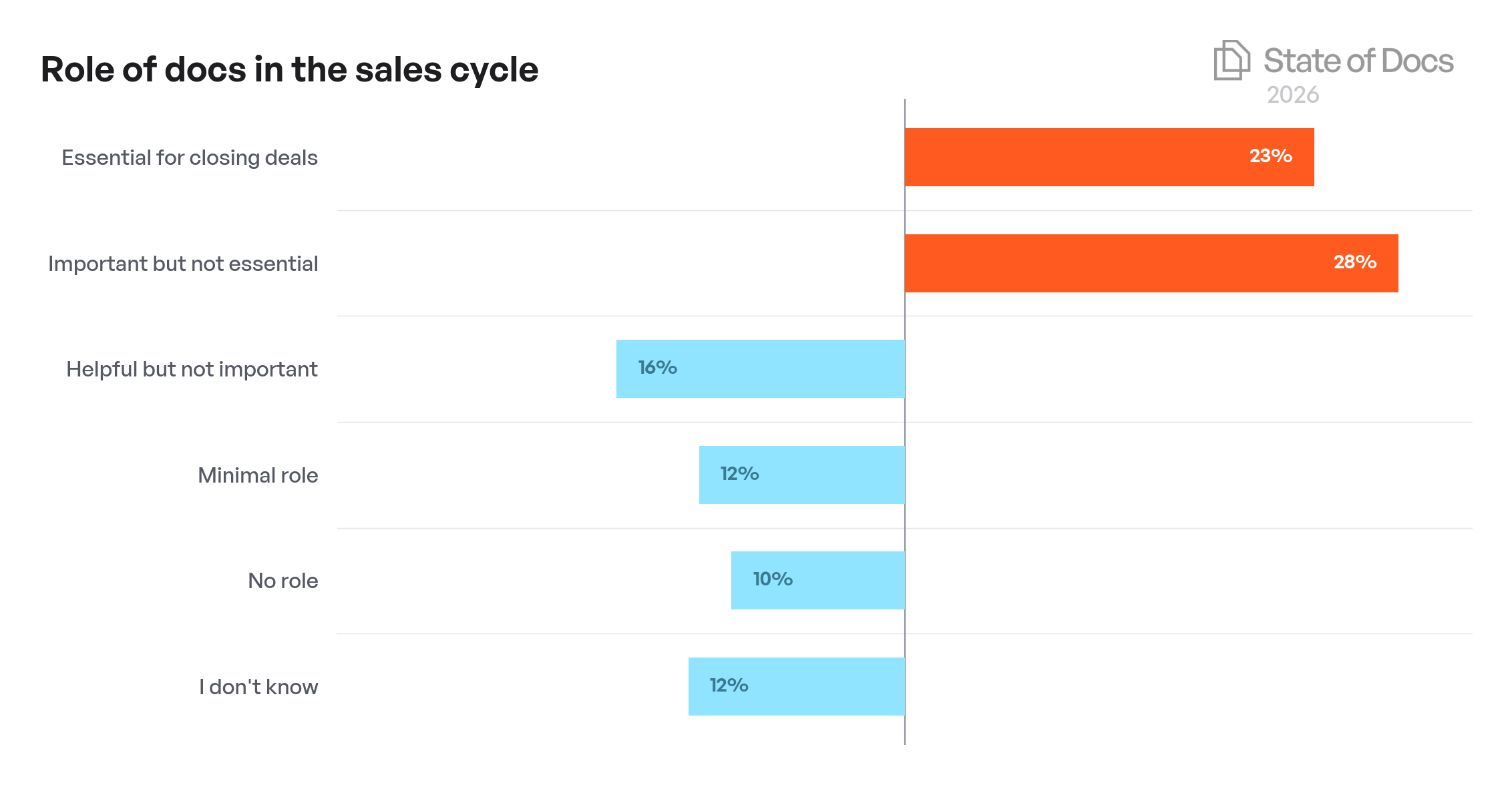
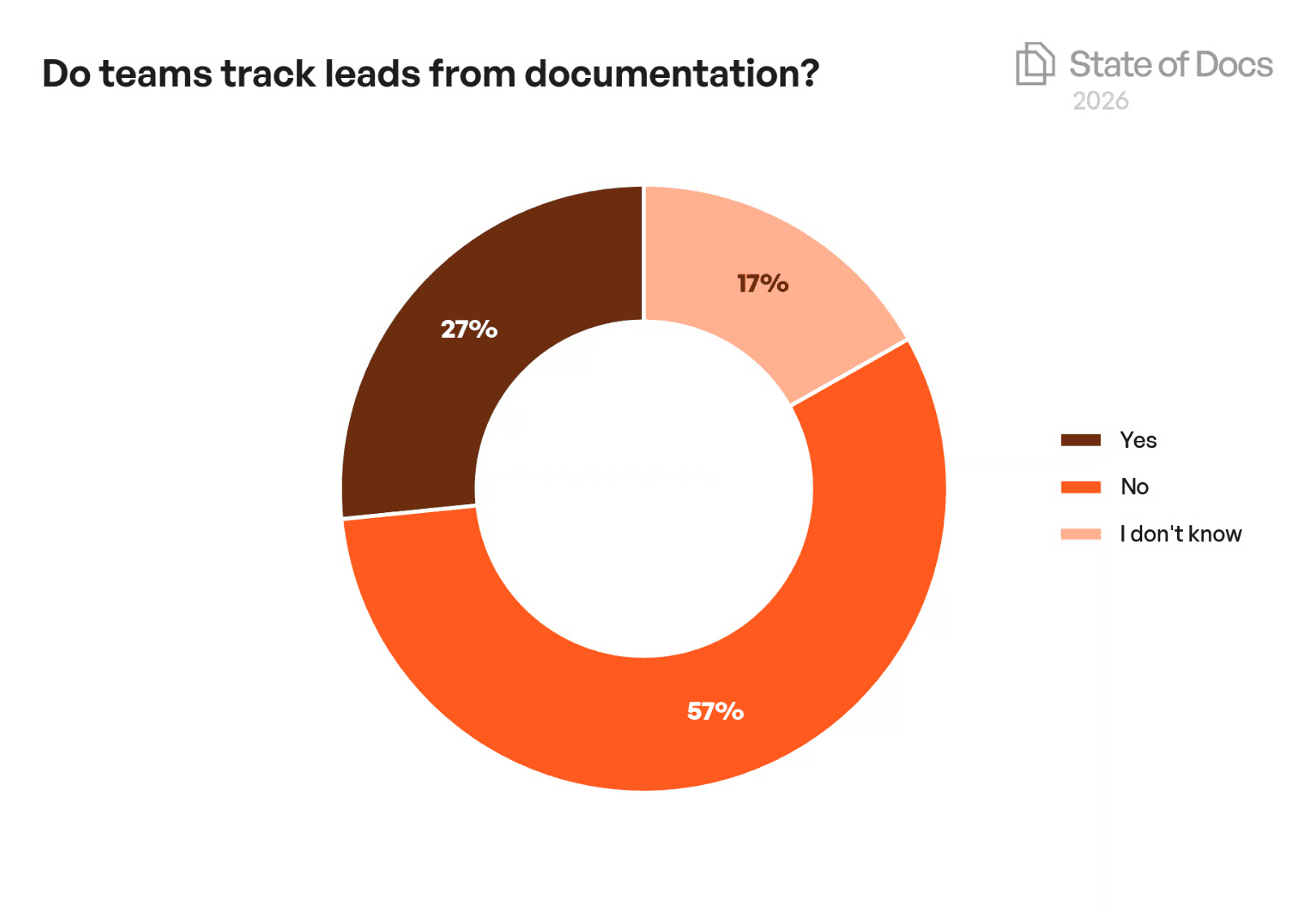
The persistent gap is between belief and measurement. 51% of respondents say docs are important or essential for closing deals, yet 57% don’t track leads from their documentation (and another 17% don’t know). Teams know docs drive revenue but aren’t instrumenting that connection — a theme explored in depth in Measuring the success of docs.
“Documentation is the biggest sales funnel. One example that is top of mind for me is Tailwind CSS. They had really good documentation that also sold the potential value of the product. That was 70–90% of their revenue, funneled through documentation.”
Hazel Weakly
Engineering Leader in Finance | Nivenly Foundation Fellow
“It’s — are they going to renew? Are they going to tell other potential users to sign up with us or not? It has real, if indirect, business impact.”
Manny Silva
Skyflow | Doc Detective
“If we have prospects looking at our documentation it needs to be a good experience from start to finish. And if it is, they’ll hit that book-a-demo button or start a trial.”
Gareth Brinn
Gravitee
“Developers don't start with the marketing site. They come to docs first. That makes documentation Docker's most important organic growth channel.”
Usha Mandya
Docker
“Documentation is the biggest sales funnel. One example that is top of mind for me is Tailwind CSS. They had really good documentation that also sold the potential value of the product. That was 70–90% of their revenue, funneled through documentation.”
Hazel Weakly
Engineering Leader in Finance | Nivenly Foundation Fellow
“It’s — are they going to renew? Are they going to tell other potential users to sign up with us or not? It has real, if indirect, business impact.”
Manny Silva
Skyflow | Doc Detective
“If we have prospects looking at our documentation it needs to be a good experience from start to finish. And if it is, they’ll hit that book-a-demo button or start a trial.”
Gareth Brinn
Gravitee
“Developers don't start with the marketing site. They come to docs first. That makes documentation Docker's most important organic growth channel.”
Usha Mandya
Docker
Year-over-year comparison
Documentation’s role in purchase decisions has solidified into a baseline expectation rather than a growing trend. The 80% review rate and 88% importance rating haven’t changed much since 2025.
This stability is notable: documentation’s commercial importance is established. The opportunity isn’t in proving that docs matter (that case is made), but in measuring and optimizing the impact that’s already there.
Strategic implications
Documentation is a proven sales asset — treat it like one. When 80% of decision-makers review docs before buying and 88% rate them important, documentation is part of the sales process. Teams that connect docs to conversion metrics can prove this to leadership in terms they understand.
LLM/AI representation is the emerging frontier. 32% of respondents say docs currently serve to “provide representation for LLMs/AI” — a category that didn’t exist in 2025. It also has the smallest gap between current and desired impact (-8pp, compared to -28pp for onboarding), meaning teams already see this as a high-potential area. Documentation is quietly becoming the data layer that feeds AI products, and the teams investing now are positioning for where discovery is heading.
The conversion gap is real and measurable. Similar to last year, half of respondents say docs matter for deals, but most don’t track the connection. The teams that figure out this measurement — linking documentation to sign-ups, trials, and revenue — will have a significant strategic advantage.
“Technical documentation is the foundation of marketing for any tech product. People don't read glossy booklets when they want to choose a product — they read something that gives them the understanding of what the tool does.”
Sasha Maximova
JetBrains
“Developers aren’t telling us ‘make this thing’ unless they’re already using MongoDB. They’re saying ‘here's what I want to do,’ and the agent is deciding which tools to use. If you’re not in the agent’s frame of reference, it’s never going to come to your docs.”
Dachary Carey
MongoDB
“It's a bit of a self-fulfilling prophecy. If people don’t really value technical writing, then they don't look at the technical writers, and the technical writers are going to do a worse job. But when people see it as important and loop you in, then the value is so obvious.”
Gareth Brinn
Gravitee
“I've had so many conversations with writers around, ‘How do I prove that what I’m doing matters? How can I demonstrate ROI in ways that will feel compelling to my higher-ups?’”
Kate Mueller
KnowledgeOwl | The Not-Boring Tech Writer
“Technical documentation is the foundation of marketing for any tech product. People don't read glossy booklets when they want to choose a product — they read something that gives them the understanding of what the tool does.”
Sasha Maximova
JetBrains
“Developers aren’t telling us ‘make this thing’ unless they’re already using MongoDB. They’re saying ‘here's what I want to do,’ and the agent is deciding which tools to use. If you’re not in the agent’s frame of reference, it’s never going to come to your docs.”
Dachary Carey
MongoDB
“It's a bit of a self-fulfilling prophecy. If people don’t really value technical writing, then they don't look at the technical writers, and the technical writers are going to do a worse job. But when people see it as important and loop you in, then the value is so obvious.”
Gareth Brinn
Gravitee
“I've had so many conversations with writers around, ‘How do I prove that what I’m doing matters? How can I demonstrate ROI in ways that will feel compelling to my higher-ups?’”
“When you can put a dollar figure on documentation’s impact, it changes every conversation with leadership. It goes from ‘nice-to-have’ to ‘critical infrastructure’.”
Larry Ullman
Principal at Stellar Docs | First tech writer at Stripe
“When you can put a dollar figure on documentation’s impact, it changes every conversation with leadership. It goes from ‘nice-to-have’ to ‘critical infrastructure’.”
Larry Ullman
Principal at Stellar Docs | First tech writer at Stripe