Doug Purcell, Diana Payton, Mirna Wong, and Kate Mueller
AI is changing the work, not replacing the workers
Vinay Payyapilly leads documentation teams at New Relic and has been in the technical writing profession for over 25 years. The AI age has led him to one of the most interesting management challenges of his career: navigating AI expectations from two directions at once.
“Managing expectations from the leadership, and managing the fears of my team. To calm everybody down and tell them that we aren’t there yet. That was for the stakeholder and the leadership, but also for my team — to calm them down and let them know that all these experiments we are running are not just to replace them as writers.”
Rather than waiting for AI to arrive as a threat, Payyapilly’s team identified their actual bottleneck: not writing, but waiting for information. He built an agent that monitors Jira, Confluence, Figma, and Slack to surface what writers need before they have to ask for it.
“Now I’m no longer waiting for people to come back to me, and that really is a game changer. More than the writing, because we can write up stuff pretty quickly.”
His advice to writers is direct: embrace the technology, but understand what real AI proficiency actually means.
“AI comfort means asking it to synthesize content from specific resources and create content that is going to be consumed by somebody else. And you need to know where the pitfalls are.”
“Embrace technology. You don’t need certifications, but you should definitely be playing around with AI. You should know what its capabilities are, what it can and cannot do. The rest of the things stay the same — being curious, using the software that you’re writing about, being aware of what the style guide is.”
He’s also watched the hiring criteria flip over the course of his career.
“Earlier we looked for people who were strong with language and were interested in technology. That’s actually been flipped. We are actually looking for people who understand technology, are comfortable with technology, and are reasonably good with language.”
And he sees a new role emerging — something like a content auditor, someone who owns the accuracy and freshness of everything a company’s AI systems might train on. It’s a role that requires the deepest institutional knowledge on the team: “It’ll typically fall on the senior most member of the team, the one who’s seen the change the most, so they know where the skeletons are hidden.”
Aleksandra Zolushkina at JetBrains sees the uncertainty from inside a major technology company. JetBrains’ technical writers are not heavily using AI for content creation, and management isn’t pushing them to.
“Everyone is now trying to do AI, but nobody knows what’s going to happen in the future. I think it’s this kind of state of panic across the entire IT field right now.”
Rather than treating that uncertainty as a reason to disengage, she’s focused on what remains durable.
“You can generate a whole bunch of text with AI right now, but AI can’t give meaning to those words. You have to do it. And you have to make sure that this meaning is as precise as possible.”
“People who can write quality content with empathy to users, they’re the ones who are relevant right now.”
Doug Purcell, who organizes Write the Docs meetups in the Bay Area, is building community around the transition: “AI is not going away. We need to figure out how to coexist with it.” Diana Payton puts it simply: “Don’t be scared. The industry has always been in flux. And communication, good communication, is always valuable and will continue to be so.”
Mirna Wong at dbt Labs offers a reframe: “Trust your instincts, trust yourself. Lean into your strengths. The quicker you learn to use AI, the quicker you find your niche.” And Kate Mueller at KnowledgeOwl adds an important counterweight: “If you shortcut the writing process, you shortcut the thinking. And the thinking is the actual value.”
The profession is navigating real change — in hiring criteria, in daily workflows, in what the job even looks like. But the practitioners finding their footing share a common approach: they’re experimenting with the tools, staying honest about what works and what doesn’t, and protecting the judgment and curiosity that no model can replace.
Doug Purcell, Diana Payton, Mirna Wong, and Kate Mueller
AI is changing the work, not replacing the workers
Vinay Payyapilly leads documentation teams at New Relic and has been in the technical writing profession for over 25 years. The AI age has led him to one of the most interesting management challenges of his career: navigating AI expectations from two directions at once.
“Managing expectations from the leadership, and managing the fears of my team. To calm everybody down and tell them that we aren’t there yet. That was for the stakeholder and the leadership, but also for my team — to calm them down and let them know that all these experiments we are running are not just to replace them as writers.”
Rather than waiting for AI to arrive as a threat, Payyapilly’s team identified their actual bottleneck: not writing, but waiting for information. He built an agent that monitors Jira, Confluence, Figma, and Slack to surface what writers need before they have to ask for it.
“Now I’m no longer waiting for people to come back to me, and that really is a game changer. More than the writing, because we can write up stuff pretty quickly.”
His advice to writers is direct: embrace the technology, but understand what real AI proficiency actually means.
“AI comfort means asking it to synthesize content from specific resources and create content that is going to be consumed by somebody else. And you need to know where the pitfalls are.”
“Embrace technology. You don’t need certifications, but you should definitely be playing around with AI. You should know what its capabilities are, what it can and cannot do. The rest of the things stay the same — being curious, using the software that you’re writing about, being aware of what the style guide is.”
He’s also watched the hiring criteria flip over the course of his career.
“Earlier we looked for people who were strong with language and were interested in technology. That’s actually been flipped. We are actually looking for people who understand technology, are comfortable with technology, and are reasonably good with language.”
And he sees a new role emerging — something like a content auditor, someone who owns the accuracy and freshness of everything a company’s AI systems might train on. It’s a role that requires the deepest institutional knowledge on the team: “It’ll typically fall on the senior most member of the team, the one who’s seen the change the most, so they know where the skeletons are hidden.”
Aleksandra Zolushkina at JetBrains sees the uncertainty from inside a major technology company. JetBrains’ technical writers are not heavily using AI for content creation, and management isn’t pushing them to.
“Everyone is now trying to do AI, but nobody knows what’s going to happen in the future. I think it’s this kind of state of panic across the entire IT field right now.”
Rather than treating that uncertainty as a reason to disengage, she’s focused on what remains durable.
“You can generate a whole bunch of text with AI right now, but AI can’t give meaning to those words. You have to do it. And you have to make sure that this meaning is as precise as possible.”
“People who can write quality content with empathy to users, they’re the ones who are relevant right now.”
Doug Purcell, who organizes Write the Docs meetups in the Bay Area, is building community around the transition: “AI is not going away. We need to figure out how to coexist with it.” Diana Payton puts it simply: “Don’t be scared. The industry has always been in flux. And communication, good communication, is always valuable and will continue to be so.”
Mirna Wong at dbt Labs offers a reframe: “Trust your instincts, trust yourself. Lean into your strengths. The quicker you learn to use AI, the quicker you find your niche.” And Kate Mueller at KnowledgeOwl adds an important counterweight: “If you shortcut the writing process, you shortcut the thinking. And the thinking is the actual value.”
The profession is navigating real change — in hiring criteria, in daily workflows, in what the job even looks like. But the practitioners finding their footing share a common approach: they’re experimenting with the tools, staying honest about what works and what doesn’t, and protecting the judgment and curiosity that no model can replace.
The documentation profession is undergoing its most significant role transformation in a generation and the data is unambiguous about the direction. Writers are spending less time drafting and more time validating. Hiring criteria are inverting. New roles are emerging that didn't exist two years ago.
What the survey can't fully capture is the human texture of that shift: the anxiety sitting alongside the opportunity, sometimes in the same person. The featured voices in this section hold both at once: a 25-year veteran navigating pressure from leadership and fear from his team simultaneously; a senior manager at a major technology company who sees the uncertainty clearly and has chosen to focus on what remains durable regardless of what AI does next.
That tension — between genuine disruption and genuine opportunity — runs through everything this section covers: how the role is changing shape, what skills matter now, where time is being freed and where it's being consumed, and what the profession looks like for the people navigating it well.
The role hasn’t shrunk — it’s changed shape
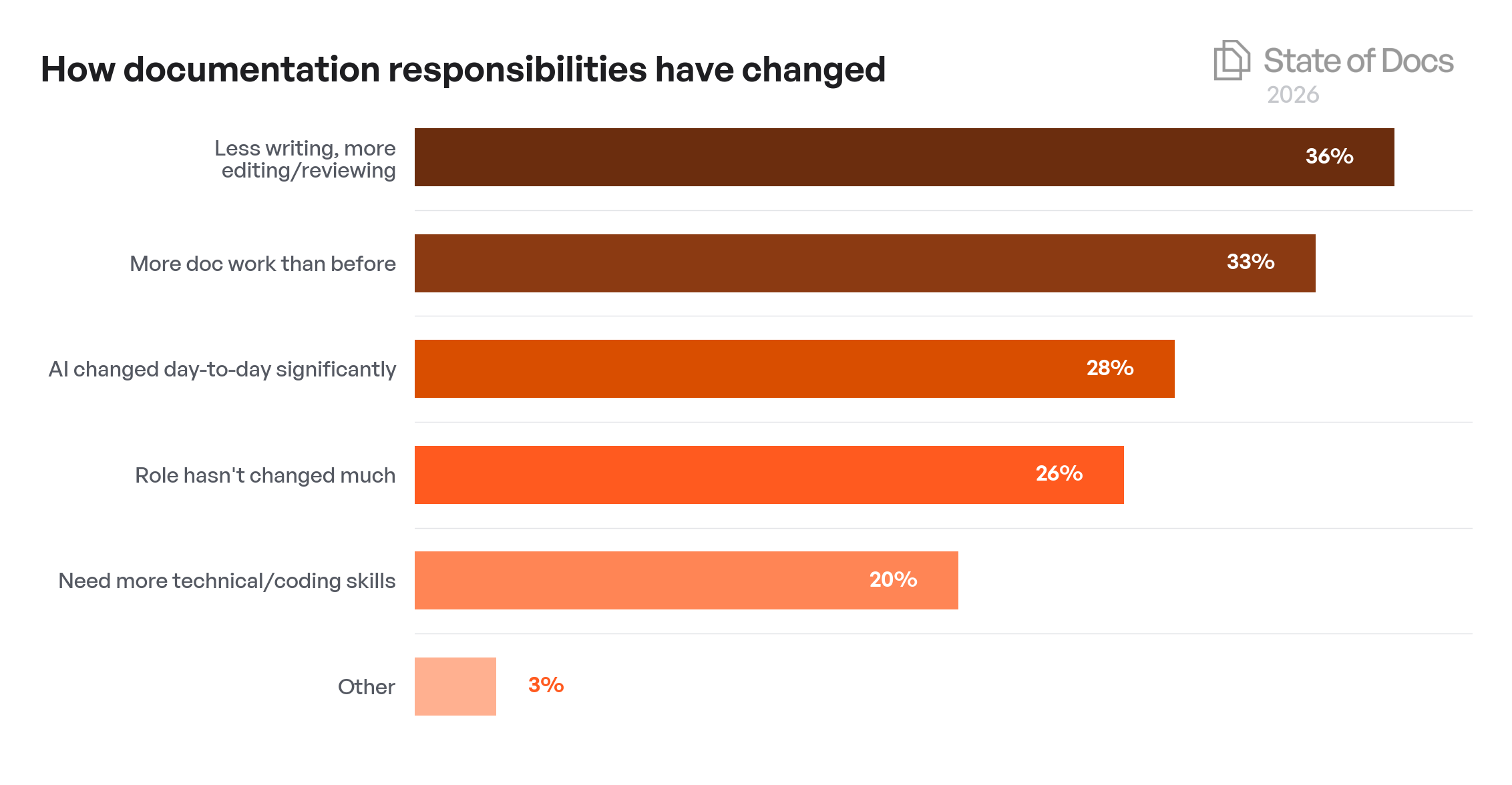
A third of respondents report doing more documentation work than before. 28% say AI has changed their day-to-day significantly, while 26% say their role hasn’t changed much. The profession is splitting into AI-transformed and traditional tracks.
“Maybe the job description will change in the future — more like information architect, content strategist — and push into more specialized roles. We’ll be given a set of tools to orchestrate a user experience rather than just sitting there and typing out the procedure every day.”
Gareth Brinn
Gravitee
“I don’t think technical writing is a very good word. Writing and words are not always the best way for people to learn. As documentation people, we can influence developer experience as a whole, and it doesn’t always have to be about just writing lots of words.”
Chris Chinchilla
Supabase
“As a hiring manager in 2027, what I would love for a candidate to come in and tell me is, ‘Over the past year, I did these experiments, and these are the two things I found AI tools really helpful with, and here's how I incorporated that into practice.’”
Christopher Gales
Technical Documentation Leader
“The artifacts that writers produce have shifted — we now write prompts, claude.md files, and shared skills alongside documentation, changing both the outputs and the audience.”
Marco Spinello
Booking.com
“Maybe the job description will change in the future — more like information architect, content strategist — and push into more specialized roles. We’ll be given a set of tools to orchestrate a user experience rather than just sitting there and typing out the procedure every day.”
Gareth Brinn
Gravitee
“I don’t think technical writing is a very good word. Writing and words are not always the best way for people to learn. As documentation people, we can influence developer experience as a whole, and it doesn’t always have to be about just writing lots of words.”
Chris Chinchilla
Supabase
“As a hiring manager in 2027, what I would love for a candidate to come in and tell me is, ‘Over the past year, I did these experiments, and these are the two things I found AI tools really helpful with, and here's how I incorporated that into practice.’”
Christopher Gales
Technical Documentation Leader
“The artifacts that writers produce have shifted — we now write prompts, claude.md files, and shared skills alongside documentation, changing both the outputs and the audience.”
Marco Spinello
Booking.com
The new skill profile
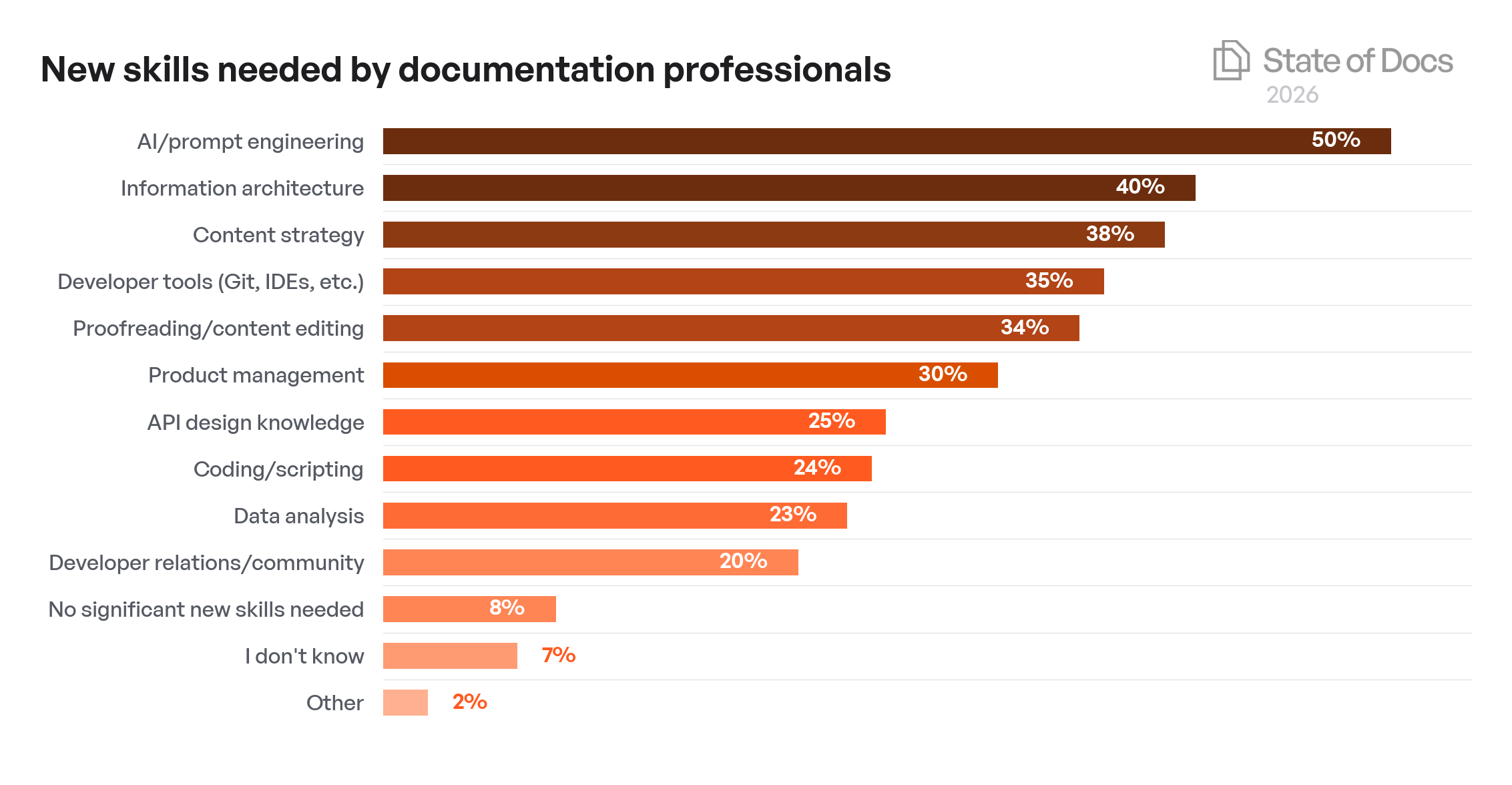
AI/prompt engineering is the #1 new skill at 50%, but the strategic skills matter nearly as much — information architecture (38%), content strategy (36%), and developer tools (35%) all rank high:
Only 9% say no new skills are needed. The emerging documentation professional looks less like a writer and more like a technical content strategist who uses AI as a production tool.
And notably, AI governance is becoming part of the skill set: as we saw in the AI creation section, only 44% of teams have AI guidelines despite 76% using AI regularly. The professionals who can establish and maintain those governance frameworks — not just use AI but set the rules for how their organization uses it — are filling a critical gap.
“People have this limited perception of what we do. They’ll say, ‘We don't need writers, AI can take care of the commas and the capitalization,’ when they don't realize that is the smallest component of what we do.”
Liz Argall
lizargall.github.io/
“If you do not know technical writing, then you will not be able to get technical writing done, whether you have AI or not.”
Utsav Banerjee
New Relic
“My entire career, writing is actually the minority of my time. I spend a lot more time doing research.”
Ian Alton
Airbyte
“You need to learn how to advocate for your value. The information architecture, the advocating for the user, the making decisions — with AI, we’re more editors, but we’re also more information architects.”
Larry Ullman
Stellar Docs | Former Stripe
“People have this limited perception of what we do. They’ll say, ‘We don't need writers, AI can take care of the commas and the capitalization,’ when they don't realize that is the smallest component of what we do.”
Liz Argall
lizargall.github.io/
“If you do not know technical writing, then you will not be able to get technical writing done, whether you have AI or not.”
Utsav Banerjee
New Relic
“My entire career, writing is actually the minority of my time. I spend a lot more time doing research.”
Ian Alton
Airbyte
“You need to learn how to advocate for your value. The information architecture, the advocating for the user, the making decisions — with AI, we’re more editors, but we’re also more information architects.”
Larry Ullman
Stellar Docs | Former Stripe
The time rebalancing
The divergence is symmetric and striking:
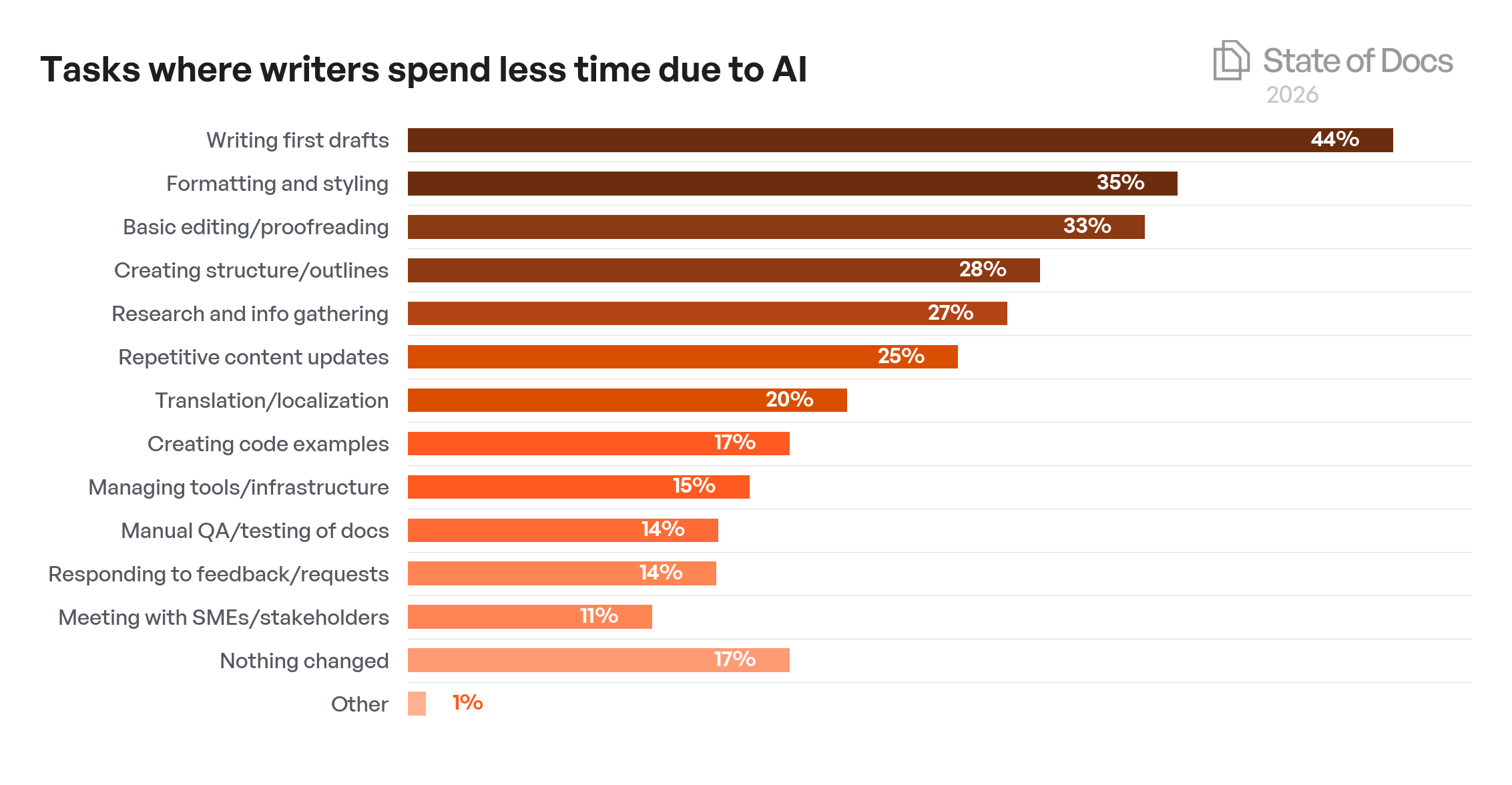
Time freed (tasks taking less time):
Writing first drafts: 44%
Formatting/styling: 35%
Basic editing: 33%
Creating outlines: 29%
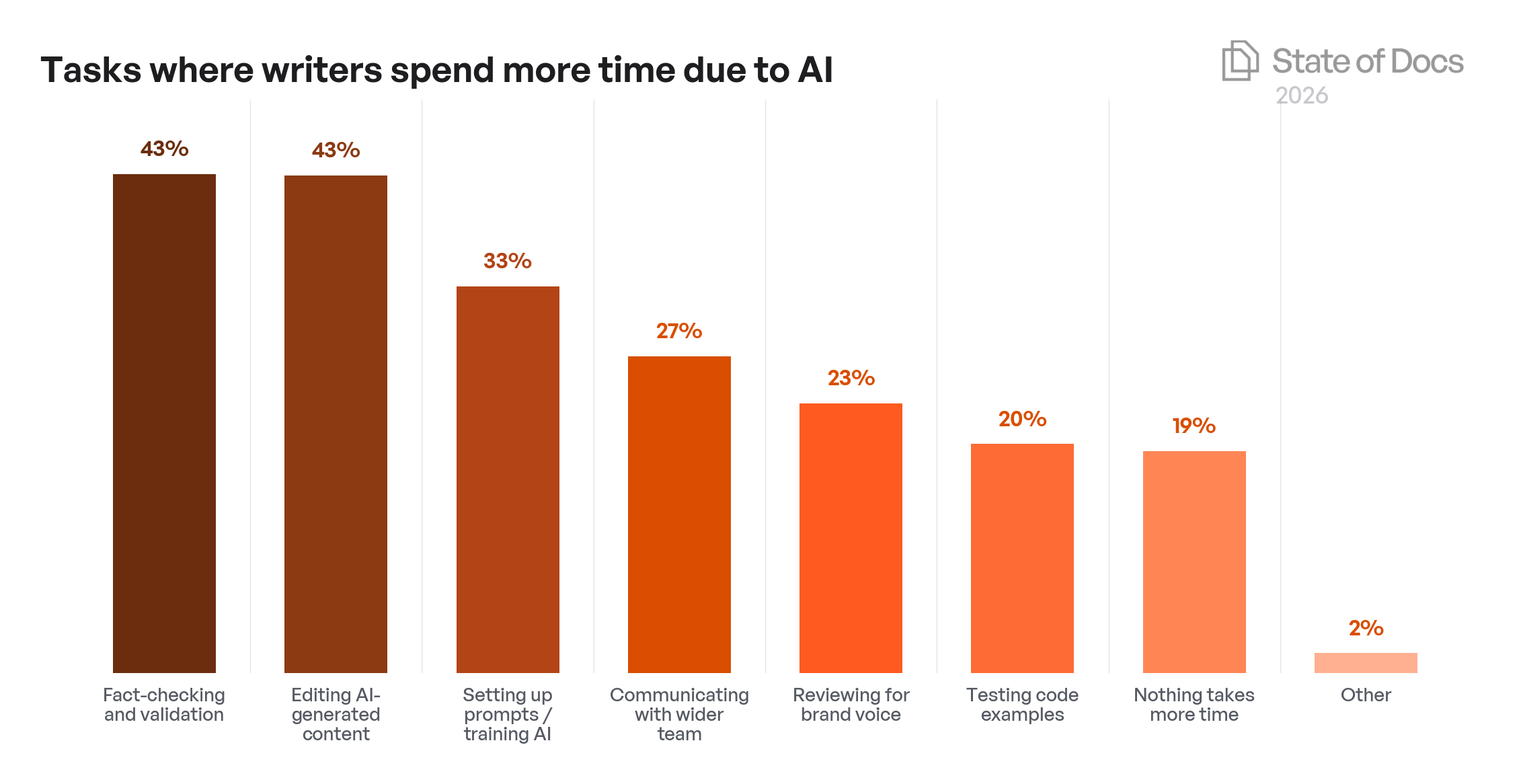
Time consumed (tasks taking more time):
Fact-checking and validation: 43%
Editing AI-generated content: 43%
Setting up prompts / training AI: 33%
Communicating with wider team: 27%
Tasks where humans add the least differentiated value are exactly where AI saves time. Tasks where human judgment is essential are where time is being absorbed. This isn’t automation displacing workers — it’s automation reshaping what the workers do.
“Trust your instincts, trust yourself. Lean into your strengths. The quicker you learn to use AI, the quicker you find your niche.”
Mirna Wong
dbt Labs
“There's this idea from Jessica Talisman: In every enterprise organization, there is knowledge that your human experts have, that you’re not going to be able to get simply by automatic ingestion of text.”
Abraham Raher
Former Cribl, Cisco, Google
“I think one of the most unique things that humans possess is intuition. That’s a very unique viewpoint that only you, as a tech writer in your organization, would have.”
Sandeep Medikonda
ServiceNow
“Using AI, I can find novel solutions for presenting data and showing our value. It's psychologically easier to listen to AI than a person because it feels more impartial and less emotional. Sadly, we do run the risk of AI getting all the credit, when a lot is helping folks hear what we've been saying all along!”
Liz Argall
lizargall.github.io/
“Trust your instincts, trust yourself. Lean into your strengths. The quicker you learn to use AI, the quicker you find your niche.”
Mirna Wong
dbt Labs
“There's this idea from Jessica Talisman: In every enterprise organization, there is knowledge that your human experts have, that you’re not going to be able to get simply by automatic ingestion of text.”
Abraham Raher
Former Cribl, Cisco, Google
“I think one of the most unique things that humans possess is intuition. That’s a very unique viewpoint that only you, as a tech writer in your organization, would have.”
Sandeep Medikonda
ServiceNow
“Using AI, I can find novel solutions for presenting data and showing our value. It's psychologically easier to listen to AI than a person because it feels more impartial and less emotional. Sadly, we do run the risk of AI getting all the credit, when a lot is helping folks hear what we've been saying all along!”
Liz Argall
lizargall.github.io/
The rebalancing of time captured by the survey may reflect what documentation work has always actually been — research, user understanding, judgment — with the writing portion now compressed by AI.
The anxiety is real — but so is the opportunity
Many technical writers feel the ground shifting under them, and some are experiencing real impacts — teams being reduced, junior roles not being backfilled, pressure to prove that AI can’t replace them. That anxiety is understandable, and it would be dishonest to minimize it.
But the data doesn’t tell a simple “the profession is shrinking” story. A third of respondents report doing more documentation work than before. And the broader tech industry is going through similar disruption — engineers, designers, and product managers are all navigating the same questions about AI’s role in their work.
Meanwhile, a new category of roles is emerging. AI companies themselves are hiring human writers, storytellers, and documentation specialists, recognizing that the technology that can generate text still needs humans who understand how to communicate with other humans. Chris Ward hires “Docs Engineers” at Supabase. Sarah Sanders’ team at PostHog operates more like engineers than traditional writers, and since the interview, the title of team members has changed from "Technical Writer" to "Context Engineer".
The skills that make someone a great documentation professional — user empathy, clear communication, the ability to translate complexity into understanding — are becoming more valuable, not less. What’s changing is the toolkit and the context in which those skills are applied.
The practitioners we interviewed who are navigating this shift well share a common profile: they’re curious, technically adaptable, and they use AI to handle the routine work — drafting, linting, testing, style enforcement — so they can spend more time on the parts that require human judgment. They’re not AI evangelists or AI skeptics. They’re pragmatists who figured out where AI fits into their workflow and where it doesn’t.
New for 2026
This section is entirely new for the 2026 survey. We added it because the AI transition is reshaping not just documentation workflows but the profession itself — what skills are valued, how time is spent, what roles look like, and how practitioners feel about their future. Our interviews surfaced deep anxiety alongside genuine opportunity, and the survey data confirmed both: the creation-to-validation shift, the new skill profile, and the widening gap between what the profession was and what it’s becoming. These questions had no equivalent in 2025.
Strategic implications
The shift from docs creation to docs review is the clearest finding in this report. Among heavy AI users, 56% report “less writing, more editing” — compared to just 10% of those who never use AI. This gradient is consistent across all five usage levels. Documentation teams should plan for a future where hands-on-keyboard writing is a smaller part of the job and quality assurance, content strategy, and information architecture are a larger part.
Advocate for yourself as a center of organizational context. Technical writers sit at a unique intersection — they understand the product, the user, and the organizational landscape in a way that’s unusual across most organizations. In a world where AI can generate text, the value of the person who knows what the text should say goes up, not down. Writers should actively position themselves as keepers of product context, user empathy, and cross-functional knowledge — and make sure leadership sees that value.
AI makes technical writers more capable, not less relevant. The job market concerns are real — experienced writers are finding fewer roles, junior positions aren’t being backfilled, and the profession is navigating genuine uncertainty. But the upside is real too. AI tools let writers tackle work that was previously out of reach — monitoring code changes across repositories, synthesizing information from engineering tools, enforcing style at scale, auditing content for freshness. The practitioners thriving right now are the curious ones: experimenting with tools, maintaining their technical skills, and using AI to extend what they can do rather than waiting to see what it takes away.
Invest in the skills that compound with AI. AI/prompt engineering is the top new skill (50%), but information architecture (40%), content strategy (38%), and developer tools (35%) are close behind. The pattern is clear: the profession is moving upstream, from production to direction-setting. Technical skills like coding (24%) and API knowledge (25%) aren’t the job — they’re what let you do the job better, especially when paired with AI tools that amplify technical fluency.